Tuesday, February 17, 2015

Calvinism’s Scriptural and Philosophical Problems - Part 4

In Search of a Coherent Narrative


Introduction

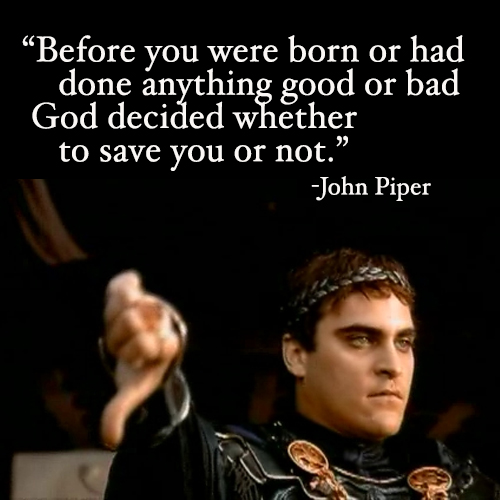
After spending some time on Arminianism, which tends to represent the power that mankind has through Freewill, we will now look at a belief that rather contrasts it. Calvinism is basically where God is so sovereign over everything that He even predestines whether we are saved and whether we are not. As Calvin and Hobbes illustrates, predestination can be a scary thought; and as we explore Calvinism, we find likewise that there is much in its narrative that can make us feel uneasy. Modern Calvinism, like Arminianism, is a popular belief in Christianity and has many variants, which range from low Calvinism to Hyper Calvinism (http://www.puritanboard.com/f15/where-you-calvinism-chart-20840/). I will seek to address Calvinism as a collective rather than focusing on its variants due to it having much in common. The five points of Calvinism will provide us with the basic overview of Calvinistic beliefs (http://www.graceonlinelibrary.org/reformed-theology/arminianism/calvinism-vs-arminianism-comparison-chart/). The five points that contrast the five Arminian points are:

-    Total Inability or Total Depravity - This concept emphasises mankind’s subjection to evil and their inability to redeem themselves from it. Even the desire to be delivered from evil is not necessarily within mankind. Many verses suggest this concept such as Jeremiah 17:9 which states that “the heart is deceitful above all things, and desperately wicked: who can know it?”

-   Unconditional Election - In opposition to Arminism’s point where mankind is FREE to choose God and contribute towards the salvation process, the Calvinist side states that mankind cannot come to salvation without God’s initiation. The emphasis is on God’s CHOICE on who to save and has nothing to do with man’s generation of faith toward God. God is the one who gifts faith, and therefore mankind is not the one who originally provides it. Due to Total Depravity, mankind has no merit that would cause God to choose one person over another - there are no conditions. God chooses whom He chooses according to His plan. It is solely by God’s sovereign grace that He chooses certain individuals to be saved.

-    Particular Redemption or Limited Atonement - Christ’s death, and therefore salvation, only has an EFFECT on those who are chosen by God to receive it. Although many Calvinists believe that Christ’s death is sufficient for all, they believe there is no general atonement effective for all mankind. People cannot access Christ’s atonement of their own accord but a limited number are chosen by God. God gives the faith necessary to accept the atonement of the cross.

-      The Efficacious Call of the Spirit or Irresistible Grace - This is concerning the call of the Spirit. There are two types of calling to salvation. The first calls people generally, such as the preaching of the gospel, which can be resisted. The other calling is where the Holy Spirit calls inwardly to those who are chosen by God. The latter call is irresistible and therefore results in the salvation of those whom God choses to call inwardly.

-    Perseverance of the Saints - On this point, Calvinists agree with some Arminianists that salvation is permanent. There is no chance of falling away. Thus, those who are chosen by God, persevere without the possibility of falling away.

It is worth mentioning that some people only adhere to some of the five points of Calvinism, but I will leave that to one side for the purpose of this post.

General Framework

Calvinists still have the same general Biblical framework as Arminianism but differ on the process (which we shall see further along). For example, they believe in the fall of man and the Biblical narrative of moving towards and completing God’s master plan. This plan was to send His Son Jesus Christ to pay the price for mankind’s sin and draw them to Himself. So Calvinism falls very much into a Christian theology like Arminianism.

Calvinist ideas can vary according to the different nuances they hold, but they have the same underlying current in their thought. Some Calvinists believe in the “kind” gesture offering where God calls literally ALL mankind to salvation and desires all mankind to be saved, but God values some other (unknown?) higher priority or reason other than effectually saving all people. Arminianists are similar in that they do not believe that God will save everyone, because He considers His adherence to Freewill greater than His desire to save all people (1 Timothy 2:4). I am not actually certain what the Calvinist big picture is that could warrant not saving everyone, but one suggestion I have heard is that evil must continue to exist as an example of sin and justice – if one cannot comprehend or experience evil, then how will one know what good is? Calvinism emphasises that grace and therefore salvation from this evil is given to a few rather than to the many. Even Matthew seems to claim it – “Many are called but few are chosen” (Matthew 22:14). In both paradigms of Arminianism and Calvinism, God actively chooses not to save some people. Ultimately, the Calvinist paradigm says that God is on the throne and He is sovereign to do as He wishes, and Arminianism suggests that God’s hands are tied behind His back and so He has handed mankind’s destiny over to themselves.

A denial of Freewill and an emphasis on Free Agency
Some Calvinists tend to deny Freewill and rather see people as being Free Agents. Free Agency means that people are who they are; people are not free to decide what their will is to be, but they are free to act out what their will is. Their will is subject to and intimately connected with their nature (how they were originally made to be). It is to be noted that Calvinists can claim Freewill in some aspects, but deny that this Freewill has any ultimate ability to choose God without God’s assistance. For the purpose of this post, I will address Calvinist thought from a Free Agency perspective because I believe this best addresses the issues at hand.

Scriptural Attraction

The attraction to Calvinism has a scriptural basis. Calvinism adheres to verses such as the ones I have already mentioned earlier in Part Two which point out God’s sovereignty over our lives. Here are some verses Calvinists hinge their beliefs on: In Calvinism, God gifts to each a measure of faith, therefore mankind doesn’t generate their own faith (Romans 12:3). This is important because Hebrews tells us that without faith it is impossible to please God. Romans 9 also is a chapter that seems to support Calvinism where God is situated as the potter and we are the clay. The potter shapes and we respond. He makes some vessels for wrath and destruction, and some into beautiful vases. Calvinism also emphasises the predestination of God’s choice regarding who will be the elect (Romans 8, Ephesians 1). To a Calvinist, God is the initiator of salvation, not man. He opens mankind’s eyes, they do not open their own - John 6:44 “No one can come to me unless the Father who sent me draws him. And I will raise him up on the last day.” The logical conclusion of Calvinism is that of recognising that God is sovereign in all aspects of reality. Many years ago I remember hearing R.C. Sproul Jr saying that if we truly understood the very first of the Bible “In the beginning God…” then we would all be happy Calvinists. Why? Because this verse states that everything that exists comes from God. God is the Creator and He does not give up His sovereignty.

Consequential Comfort

Calvinists tend to enjoy the idea that God is Sovereign over everything and this ultimately gives comfort. God being sovereign leads to believers having surety that He will keep them as His. The changes that He requires in them, He will do. They do not need to stress about their ability to become like Christ, because He will do the work in them. I am not saying that Calvinists do not believe in wanting to or trying to become like Christ, but that they do not need to worry about falling away. The attractiveness of Calvinism is that it gives God more power in everything that happens. To the Calvinist, God can be relied upon, instead of worrying about the outcome of our lives.

River Analogy

A helpful way of looking at Calvinism would be to use the drowning man in the river analogy mentioned in an earlier post. Joshua Griffiths, a good friend of mine, came up with the idea that a Calvinist would tend to see salvation like a man drowning in a river who is powerless to save himself. He is even unable to grab hold of a rope that is thrown to him. He is so delirious that he does not even want to. God would need to jump into the river, give him a shot of adrenaline, wake him up and swim with him to shore. The Calvinist would say that he did not choose to be saved but God placed a desire within him to be saved, thus persevering to shore with God’s strength. Arminianism contrasts this scenario by suggesting that the drowning man of his own accord saw the merit in grabbing the rope and in the end allowed God to pull him to shore.

Criticisms of Calvinism


The Elite and the Excluded

The criticisms of Calvinism that I have are from a scriptural and a philosophical angle. As the Arminians point out, the scriptures talk of God holding mankind as responsible for their own actions, and His anger is lit against them to the point of eternal separation (some say even “eternal conscious torment”) or even annihilation. Yet in Calvinism, mankind has no option to choose salvation, only the few elite that God has chosen. The “many” who are left behind may be able to consider being saved, but ultimately due to Free Agency and Total Depravity they will always be separated from God. This thinking leads me to a moral criticism. If God expects people to act a certain way and gets upset that they do not (when they are unable to), His expectations are obviously far above people’s abilities. Not only this, but He gets so upset that He ultimately punishes them with eternal separation from Himself. To me, this does not fit the character of God that the Bible reveals to us. Any father who banishes his child forever from His sight because his child made a wrong choice, even though he had no real choice, would be a horrendous father. In Calvinism, the separation of a group of people from Himself is sometimes seen to serve as an example of evil for the benefit of the few chosen. To me this turns God into an arbitrary monster, loving some and not others for some reason that no one can truly clarify why. If someone could come up with a good reason for God rejecting and sacrificing the majority for the sake of a few as part of a big “glorious” narrative, then I am all ears. However, as of yet, there is no cognitive reason that I see in the narrative that the Bible provides that would allow God to act in a Calvinist paradigm, especially according to the Biblical value placed on human responsibility and the expectation to act a certain way.

A Call to Love

As hard as it may be to accept the idea that we are expected to obey God and yet cannot, it gets worse. Under the Calvinistic paradigm, God expects us to love and value Him. However, Calvinism’s narrative also makes it very difficult to love or value God. At this moment, I cannot see how I could truly love and value a God who picks and chooses between people based on no apparent conditions, i.e. arbitrarily. To put it mildly, it would be like a child trying to love a father who permanently picks and chooses between His favoured and disfavoured children in the family for eternity. The child who is chosen by the father may for a moment be able to reciprocate the love the father shares with him. However, the child may look at his sister and ask why the father chose to love him instead of her. It seems unjust. Rather, throughout His Word, God often (if not always) appeals to past good works He has done for people in order to evidence why they should follow Him. He is appealing to them to understand that He is good to them, and that He is not just the God who whimsically or arbitrarily does as He pleases.

Death’s Persistent Sting

Another philosophical problem I have with Calvinism is that God detests evil and yet allows it to exist in the majority of his creation for all of eternity! Not only this, but God claims to have created man in His own image. I realise there is much ambiguity as to what this means but by principle if God created man in His own image, then how can man be forever estranged from their Creator, living under an entirely different image? Even if man was annihilated (as in Annihilationism), there would have been in existence an “image” of God in the creation of man where a man had no potential good in him worth saving. This brings me to a further thought; If God created this universe to be “good” and even called it “good”, how on earth (literally) did it go “bad”? Since He called it “good”, one would expect it to be “good” with no existing or potential evil. However, He planned for evil or at least knew that it would become evil. According to Calvinism, the evil that came after God had called creation good became a large part of creation. Paul’s question of “death where is your sting?” might be a boast about his own salvation from death, but the majority of humanity are subjected by God to receive for eternity this sting, or at least until annihilation. The evil in a Calvinist narrative is not merely temporary in the lives of the human populace, but exists permanently in the majority of mankind.

Calvinist Sovereignty is not Comforting

One of the values that many Calvinists seem to find comforting is the idea that God is in control of where their lives are going. For me this is not comforting. Why? Because under a Calvinist paradigm only a few are saved – thus my chances of salvation are rather slim. My chances and my neighbour’s chances of being rescued from our sins is more or less a lottery to us, and the chances are actually against us. I have no confidence that God will work out my life for good.
From my perspective on scripture, I also question the very concept of “once saved, always saved”. Many strong scriptures point towards the ability for mankind to come to and also fall away from God. The scenario of the olive tree in Romans 11 seems to be rather clear about that. Some people who were a part of the Olive tree were actually cut off and a warning given to us who had been grafted in! In John 15 where Jesus prunes off the branches which do not bear fruit seems to be an indication of the very real ability to lose our place within Christ. I realise the scenarios given include “if’s”, but the warning is real I believe, especially because some natural branches were actually cut off. The “comforting” idea behind God’s sovereignty over our decisions in a Calvinistic paradigm is not comforting, but rather troublesome and promotes worry. God has given no revealed reason to choose or not to choose me or my neighbour for salvation.    

Denied Pleasure

If God is the most desirable, fulfilling Being that provides “real” happiness in the universe, then Calvinism does not allow for this mind-set. If people in total depravation do not desire God or desire to be saved then technically they desire something else. From their perspective they are “happier” than if they were submitted to God. This means they have found pleasure that is greater than God. What if they technically would be happier and more fulfilled in a relationship with God, but do not realise that God could provide that happiness? Then God would be withholding that pleasure at the same time as blaming the majority for failing to grab hold of it. In Calvinism, I feel that the joy about us having found the greatest joy is taken away, because with thought we realise that it is not that simple. I would feel uncomfortable celebrating my joy in finding Christ my Saviour once realising that the majority people out there will be left without finding that joy in God. Not only this but the joy is not merely something that they reject, but joy that God actively prevents them from finding. They forever look over the treasure that the man “lucky” enough to have found it buried in the field (Matthew 13:44)                    

Calvinism is not all Unfavourable

Some who hold the Calvinistic viewpoint have good intentions that aim to put God back on the throne in a big way. They try to emphasise the “surety” they have in Christ’s work within themselves. Some try to sugar coat the Calvinistic paradigm by talking about the “kind gesture” of Christ’s offering of salvation to all (John 3:16). Yet these nuances are emphasised to make the appeal of Calvinism palatable, and I hope this write up would have assisted us to look at Calvinism’s core issues in a fuller light.

Summary


A key motivation of Calvinism is that it seeks to put God on the throne and places the power of man’s choice in subjection to God’s will. This appeals to those who hold Calvinistic beliefs for many reasons. The scriptures speak of God’s absolute power and sovereignty over mankind. The same scriptures are not only clear about this but also tend to make logical sense. Calvinism also claims to provide some personal comfort for those wanting to follow Christ. These reasons open up many criticisms, some of which I covered in this post. Calvinism creates a compulsory elite class and forces the elected non-elite to be excluded from the perks of being elite. Not only this, but we are expected to love the God who implements this. Contrasting Paul’s boast, under Calvinism, Death’s Sting is easily found in the masses of people subjected to it for eternity, and therefore God’s image in mankind is permanently marred with evil for eternity. Many Calvinists may seek to comfort people with certain salvation, but if we act a little less selfishly and look further than ourselves we will see that there are many who are not in comfort. Not to mention our own security within salvation is questionable due to scriptural challenges on this security. Finally yet importantly, under Calvinism, the Ultimate Pleasure is denied to the majority of mankind and what naturally follows is an alternate pleasure that is subjectively “greater” than God. For me, Calvinism like Arminianism does not provide a coherent enough narrative to satisfy my queries about the goodness of God, logical coherence and scriptural revelation. 

My next post will be the beginning of a different narrative that I believe provides a solution to the disparities in the Arminian and Calvinistic narratives. It will come from a scriptural basis, as well as from what I believe, a more logical basis than either Calvinism or Arminianism.

Monday, January 26, 2015

Faithfully Valuing the Limits of Scripture (PART 3 - RELATIONSHIPS)

Last post I used the example of progressive revelation as a sort of 'practice' engagement with the issues of faithful Scriptural interpretation, and being willing to reconsider our world-views. Progressive revelation suggests that God's purpose for Scripture may not be focused on perfect unbiased clear communication of cognitive knowledge. In fact, it demonstrates that God deliberately creates bias. This doesn't sit well with the modernistic components of our worldview, and so we tend to minimise this aspect of Scripture, and thus divert from a completely faithful approach to Scripture.


Next I want to start working through to the purpose of Scripture. But before we get to that, we need to explore what God's fundamental aim is in ALL His dealings with us. Often Christians use the same words to describe this topic, but haven't fully considered what these things really mean.


I'll always reiterate that my aim is not to challenge things for the sake of it. I just want us to be willing to challenge our worldview IF being truly faithful to Scripture and God requires it.


Background

First, some broad assumptions. I don't feel these need to be justified in this post, but feel free to use the comment section to disagree or help unpack these things more :) I think it is evident from Scripture and experience that God's fundamental aim in all things, is to express His character in as full and diverse a way as possible, so that other beings can immerse themselves in this expression and 'know' Him. Christ IS God, and contains the fullness of God as a person - something that all other expressions of God cannot come close to doing! In essence, then, all other expressions of God are actually expressions of Christ, and God's aim is that we experience and know Christ through them. This is true regardless of how clearly Christ has been cognitively identified as a distinct person - even in the Old Testament era, God's aim was for people to experience Him (which means experiencing Christ). 


Framed from our perspective, humanity's purpose has always been to experience Christ in a positive and reciprocal way - otherwise known as a relationship of love. This love involves an inclination of our heart toward enjoying this relational engagement with God's character (Christ), wrought by the Holy Spirit. God and Christ are unchanging, therefore the inclination of all God's people's hearts have been directed (by the holy spirit) toward the same person - despite the fact that the conscious experience / revelation of Christ's character varies enormously in its cognitive clarity. This is why Christ accused the Pharisees of not accepting Him - although they appeared to have the right relationship outwardly, they did not have the mark of the Spirit in their hearts - they did not love Christ unconsciously before He was revealed, and so they did not recognise or love Him when he was revealed. God wants us to have this relationship of love even when our conscious cognitive understanding of the details of this relationship are not clear. As it becomes clearer, we will rejoice because the relationship of love already exists in a less 'realised' form. 


But how exactly does a 'relationship of love' behave? What do we really mean when we talk about relationships? There are several interesting observations about relationships (as God's fundamental aim) that run against our 'modernistic' leaning to prioritise detailed cognitive information. Essentially, it makes no sense to conceive of a relationship in terms of a definable 'fullness' that we can attain to. To start with, relationships are ongoing - no amount of expression is enough for a person to have fully expressed themselves or been experienced by another. Also, the expressions and experiences of relationships are creative and dynamic - it is good for individual snapshots of a relationship to express varied aspects of the person rather than everything at once. Even focusing on the concept of 'fullness' in a relationship can be detrimental and insulting - we enjoy the interaction of friends or spouses in the moment, because it expresses who they are. Analysing the clarity of our perception of them through this experience misses the point entirely.  Finally, two people could potentially have the 'same' relationship with another person (i.e. two of my close friends, two of my brothers brothers, two of my elders, two children, two soccer opponents), and yet because each of THEM is different,  each relationship will look different. Even if I can't distinguish between the two relationships in terms of 'health' or 'fullness' or 'inferiority/superiority', the relationships will still be different (including the cognitive conscious interpretations). This isn't because each is imperfect - even in the theoretical (impossible) case where each person fully and accurately cognitively grasping me, the emphases and flow of awareness of each person's cognitive understanding of me will still be different. This isn't because each is incomplete, but because a static definable 'fullness' doesn't make sense, and so identical 'fullness' is impossible. It's just an integral positive aspect of what 'relationship' means. 


Cognition

Am I really saying that cognition is not very important to relationship, which is God's fundamental aim? Well, yes and no. To start with, there is dissonance between specific cognitive information and proper relationships, as discussed above. Cognition is merely one way to experience someone - just like no particular 'experience' or 'set of experiences' can define a relationship, so neither can a particular cognitive understanding. Even for God, complete intimate and perfectly accurate cognitive knowledge about someone (which I believe He has) does not mean He 'knows' a particular person in the sense that matters (He talks about 'never knowing' people who He casts out), and doesn't seem to be a big part of what He means when He does 'know' us this way. But on top of its problems integrating into relationships, cognition on its own can't even live up to what we expect of it, at least not for humans in this life. It is inherently inaccurate and extremely fallible due to both the inabilities of our mind AND due to deliberate strategies our minds employ! Our minds can only conceive of things that it has developed to be ABLE to conceive of - experience, background, developmental framework, personality and creativity types, what is suggested to us in the moment, all limit our abilities to actually think of or interpret certain things. Not only that, but our minds deliberately employ strategies that make life more efficient but extremely biased - e.g. confirmation bias. Our world-views, desires, existing understandings, etc ALL automatically / subconsciously heavily taint our interpretation of cognitive data - which is what they are designed to do, and which is what makes them useful in everyday life. 


God certainly has the ability to overcome and manipulate all of this as He sees fit when it comes to our theology, but experience and research suggest that He certainly does not do so within His church - we all still adopt a multitude of aspects in our worldview from our cultural surroundings which almost universally predict what our theology will be. And Scripture does not suggest God wants to manipulate this too much either - instead, the Spirit's primary activity seems to be in inspiring love in our hearts (as already discussed), and bringing the experience of the expression of Jesus to us in a more personal way. The Scriptural concept of 'mind' is actually closer to our modern idea of 'will' or 'intentions' or 'attitudes' than anything else, and not detailed cognitive information. And when Paul does speak of doctrine's importance, he uses much the same language as when he talks about works - important, but not God's fundamental aim or method. When we insist that God must routinely enable us to overcome our cognitive weaknesses when it comes to e.g. 'salvation doctrinal issues', we usually do this as a blatant attempt to protect our worldview (by maintaining the importance of detailed accurate cognitive information). God seems to have left us with a very flawed and tainted cognitive interpretation of our otherwise healthy Spirit-wrought relationship with Him - which, like everything He does, must be a deliberate decision for a good purpose. So particular accurate cognitive information is not as important to God as we tend to think. 


But I'm NOT saying that cognition as a process (fallibility and all) is unimportant to God. There are actually several ways that cognition is unique as a mode of experiencing someone, despite its limitations, and thus becomes uniquely  important. First of all, the process of cognition is still required for us to actually consider a relationship 'valid'. You can't enjoy and experience another person in relationship, when their expressions seem to you to be merely a bizarre set of unrelated random experiences. You must engage your cognition to form a picture (incomplete and evolving) of the other person. This picture also enables a relationship to persist when the experiences are limited in some way. And it enables us to grow in a relationship far beyond the concrete limits of our experience - We take our experiences and extrapolate back to what the person must (or could) be like, and where our relationship could take us, exploring this in our minds and 'experiencing' it in an abstract way. This cognitive picture has serious problems as mentioned above - but the process of engaging the cognition in this way is essential to relationships. Second, cognition is required for a relationship to mean anything to us. Relationships have qualities attached to them, like love and hate, which are necessarily driven to be expressed. This drive is partly experienced in our cognition, and requires the cognition to make deliberate decisions that express love or hate - if it is love, the drive is to seek further experiences of the other person, and to express yourself and your love back to them. If these drives are able to be expressed, the relationship quality is enhanced, otherwise it seems incomplete. Its not that you must cognitively understand what you love in detail, but love necessarily engages the cognition in its drive to express itself. This means love's expression may change as it 'discovers' itself more and more in a cognitive sense. 


Communication

Cognition has another purpose - it IS part of the expression of someone. For most of us it is a very inaccurate and distant window into our heart, but even God's perfect cognition is a poor representation of His heart - that's just the nature of cognition. But it is a window into the heart, an expression of the person, and so it is important in relationship to experience the other person's cognition. Which requires our cognition to function. The process of deliberately targeting the other person's cognition is called communication. This does not necessarily mean that the mode of communication is verbal or even cognitive, or that the ultimate distant aim is necessarily cognitive either. Communication is simply a means to an end through the use of targeting cognition.


Communication suffers from three extra steps of terrible and extremely variable accuracy when it comes to capturing cognition (EVEN IF the cognition of the author is 'perfect' in accuracy, like God's arguably is). The first step is translation of cognition into communication. Communication can NEVER capture the fullness of our cognition, because it would take years to do so in any 'language' (and I doubt any 'language' has the capacity to capture all the subtle nuances of cognition). Instead, communication must have specific prioritised cognitive targets and intended effects. The second step is the interpretation of communication, which obviously (naturally and appropriately) varies between different recipients. We NEED to introduce bias into our communication if we are to help another different cognition understand our cognition - and this should never apply equally to every individual. This means that IF we are attempting to generalise our communication, we must pay even more attention to prioritising our messages, accepting that efforts spent reinforcing one message to as many people as possible, will probably sometimes have opposing effects on other associated messages or on other individuals. The third step is the impact this cognition has on individuals - in terms of integration into their existing cognition, associated non-cognitive effects, interpretation of other associated cognitive messages, etc. This varies between individuals EVEN IF they all accurately interpret the intended cognitive message.  These three steps mean that communication can simply never be a 'pure' transmission of the authors cognition, and that biased interpretations MUST exist - but this is not a problem if this very bias works towards the best interpretation of the main intended message, or toward the main purpose.


God has also specifically elected to use communication (i.e. Scripture, prophecy, doctrines, prayers) as a one of the primary tools through which we interpret the hearts of others and reach out to them, and establish and grow a relationship of love with God. This does not necessarily mean that God has elected to use PURE communication toward these ends. I don't think this makes sense (as discussed above), but also progressive revelation deliberately included some very unbalanced cognitive presentations of God. God may wish one person to grasp a particular truth strongly at the expense of other truths, while he wishes something different from a different person. In fact, since God's intentions for Scripture are relational, He must have deliberately designed the particular pattern of bias in scripture for this purpose. The fact that a particular doctrine was useful for me at a particular point in time, to grow my relationship with God, does not mean it is the 'most accurate' or 'best' (in some other way) understanding of God, or that I will never change my beliefs to give my relationship better expression in the future. I may see flaws in a particular doctrine, but it may be just as true as my doctrine (just in a different way), and it may spring from a heart that is more established in a loving relationship with God than mine - making that 'wrong' doctrine fulfil its purpose better than mine. Just like our highly fallible interpretation of works and fruit are a useful but dirty window into another's heart, so too are our highly fallible interpretation of another person's doctrines. 


Summary

You can see that I'm contrasting two things here: the spiritual relationship of love is the important underlying reality. Whereas cognition (the conscious reception of God's expression) is a dim (but important) reflection of this love. We don't have to properly understand this love in order for it to exist - and some of the improper aspects to our cognition are deliberately designed by God, which must fit with His fundamental aim of relationship with Him. Cognition & communication have many flaws and fallibilities by virtue of their very nature, and are never intended as full encapsulation of the relationship. Instead they are meant to be based upon the relationship, partial expressions of the relationship, and dirty windows into the spiritual relational realities occurring in our hearts.


Comments? Questions? Please discuss below :) Do you agree that relationship is God's fundamental aim? Do you agree with my description of relationships? Are there other ways that our cognition is meant to function in relationship? Are there other limitations to our cognition or communication? 


Coming Soon...

  • Next week I'll quickly talk about morality as very similar to communication - a flawed but important expression of cognition (itself a flawed but important expression of a person). I would have slotted it in here, but the post got too long!
  • After that we get a bit more theological and discuss why God allows bias and ambiguity and confusion about His nature. This is, after all, something I keep insisting He is doing deliberately. This discussion will specifically re-address progressive revelation, but will also expand to the general problem of evil. I'll also (hopefully, space-allowing) talk a little about how faith relates to this fundamental love relationship (as I've been calling it).
  • After that I think we'll be ready to summarise how God intends for us to approach Scripture. And then we can explore this in more detail over some of the phases of progressive revelation. 
  • Then we can talk about the Jewish and Christian MIS-approach to Scripture and the problems its created. And the inverse implications that properly approaching Scripture can have. 
  • Finally we can discuss some contemporary issues with this approach to Scripture in the back of our minds, to see how it informs our discussion and approach.

The series so far:

Saturday, December 20, 2014

Faithfully Valuing the Limits of Scripture (PART 2 - PROGRESSIVE REVELATION)

Last post I introduced the importance of  approaching Scripture honestly to allow it to speak to us as God actually intended. I expressed my concern that our subconscious faithfulness to our extra-Biblical worldviews has led to us (Christians) to add additional (unnecessary) 'requirements' to our approach to Scripture. In particular, modernism inclines us to approach Scripture as if 'detailed cognitive understanding' was of ultimate importance, because modernism requires detailed cognitive information about God in order to place Him in the grand scheme of things, and inform us how to relate to Him. We often simplify Scripture in order to allow it to fit with our worldview, and end up being faithful to a curated form of Scripture, rather than to the real deal in all its uncomfortable fullness (including those aspects that don't fit well with our worldview).

I'm not implying that these 'uncomfortable aspects' are the major themes of Scripture, and that there is little evidence for e.g. a consistent thread of doctrine, common unity in the faith amongst the authors, God's mercy in the OT and his judgment in the NT, etc. But no one needs encouragement to be faithful to these aspects! We need encouragement to be faithful to the uncomfortable aspects, because this may require us to challenge our worldview (and this is difficult because it gives us a framework for how we think and feel about, well, everything).

Our worldview may also have us believe that considering these things faithfully is actually violating the 'faith' God expects us to have. So I reiterate again, my aim is not to challenge things for the sake of it. I just want us to be willing to challenge our worldview IF being truly faithful to Scripture and God requires it.

Progressive Revelation

Today, as a kind of expanded 'introduction', I wanted to focus primarily on unpacking ONE particular aspect of Scripture that we simplify - the progressive revelation of God's character. It nicely demonstrates the uncomfortable complexity of Scripture, probably more than any of the other aspects I mentioned. And it opens up more discussions at once, than any of the others.

Most obviously, progressive revelation refers to the Scriptures as they were recorded. For example, the law was given progressively over the course of a generation, and not instantaneously. Subsequent additions were made as the Jews unpacked their culture and history in the promised land. There were many prophets, many of whom we have no record of, though some were recorded and eventually deemed 'inspired'. The NT was written over many years, and much of the church for years only had access to a mix of SOME of these materials (as well as many additional letters, which were lost over the years).

But I'm not just talking about new 'facts' being revealed about God over time. This is hardly controversial. There's also the progression in the amount and fallibility of the 'communication' available to God's people. Jews were being circumcised into the covenant community, and having faith that pleased God, for many generations PRIOR to Moses writing a word of the OT. They relied primarily on oral tradition taught by many varied 'rabbis' with varying degrees of training and experience. We could (potentially) argue that God preserved 'direct perfect and unbiased) communication through this diverse array of human instruments, but I contest this is unlikely, and we tend to argue this mainly to protect our worldview. The bottom line is that a huge number of godly saints did not have access to any 'direct perfect and unbiased' communication about God, or to the subsequent 'detailed cognitive knowledge' we deem so important today. The NT also did not exist for many years of the early church, yet these people were baptised into union with Christ. Again, they had access mainly to oral stories passed around (verified of course by the Apostles, but many of these Christians never heard directly from the Apostles - it was all third or fourth hand). And for much of the early history of the church, the OT was minimised as a source of useful instruction (either because it was deemed to be 'evil', or allegorical). So again, these believers had restricted access to any 'direct perfect and unbiased communication' about God.

Finally, and most importantly, Christ Himself - the fullest revelation of God, this time in a more 'relational' kind of communication - took his timing in coming, and even his first coming was only a partial revelation, while we await His return. Even in heaven we will continue to experience Him, meaning that He will not have finished 'expressing' Himself for eternity.

A Changing 'Image' of God

'Progressive revelation' inevitably extends to the broad picture of God presented by Scripture. We minimise this a lot to protect our worldview, but God presents a picture of Himself that markedly changes over time. Try it for yourself - read the Torah as a Exodus Jew would have read it, without any of our modern sensibilities (e.g. about Justice, slavery, women's rights, violence, etc) and without the rest of Scripture to 'balance' things out. This is just one example, but it becomes clear that in the initial stages of the OT God expects His Holy people to willingly and brutally massacre foreign children, without qualms. The God we see now (given the whole story from OT to NT) would expect people to have a heart which naturally flows out in efforts to STOP such behavior, and which would certainly question that command to massacre (was it really from God?), and at least have some qualms about it.

If we argue that God is truly unchanging (as He says), what we're saying is that for much of the OT, God blatantly restrained Himself from revealing these incredibly relevant and important 'balancing' aspects of Himself,  and thus was deliberately creating bias in how His people perceived Him. And it was not just the general populace - it was the judges, prophets, priests, holy warriors, kings - God expected His people to perform in a way which is only consistent with a lopsided view of God.

God may have been slowly weeding this deliberate bias out with subsequent revelations, and working toward a more harmonious 'accurate' picture of His unchanging Himself. But we are still left with the NT apostles differing quite radically on their doctrinal emphases. While this might not seem as drastic as claiming that they held to contradictory doctrinal 'facts', it's still saying that the God that James saw was rather different to the God that Peter saw, that Paul saw, that John saw, etc. We could go so far as to suggest that they disagreed over aspects of God's character or priorities. A common example is the relationship between works and salvation - as a broad generalisation, Paul placed works as a definite outflow of salvation, Peter places some works as a requirement of salvation (e.g. baptism), and James and John placed works and faith alongside each other. Again, we could protect our worldview by drawing attention to the 'balancing' beliefs that the apostles held, which minimised the eccentricities they communicate in Scripture and make their theologies harmonious - or sometimes, when we can't find the doctrines we're looking for, we just assume the apostles held them. But I want to value the Scriptural tendency to communicate the eccentricities very clearly, sometimes more clearly than the harmony. Scripture doesn't seem as concerned with this 'harmony' as we are.

Dividing Scripture

This discussion obviously raises questions about 'dispensationalism' vs 'covenant theology' vs other variants. As you've probably guessed, I think both views are simplifications. Progressive revelation contains components of both.

There is a consistency to the way God relates to people throughout the ages - through multiple, varied, deliberately biased (and incomplete) expressions of Himself. I'll delve more into this in later posts, but the point for now is that 'progressive revelation' is NOT saying that some 'phases' of revelation were superior to others. All of history has been in constant a state of incomplete revelation, where God has NOT yet made known his fullness in a cognitive sense. Instead, every incomplete revelation naturally combines with others over time / exposure to produce a more and more complete communication - hence the term 'progressive'. The flip-side is what I think is an obvious conclusion from any straightforward reading of Scripture - that our view of God and how we behave as His people is meant to change, between e.g. the Exodus and now.

The difficulty is trying to describe how we are meant to approach this change. Some attempt to arbitrarily divide Scripture into sections that apply in different ways to us (and some don't apply at all). But I think this approach is not faithful to Scripture. There is nothing in the Bible to suggest a division between some parts of the OT which are relevant to us today, vs those which are not. It was always considered as a whole by every Biblical author. Even when we try to 'divide' it up, we run into trouble - e.g. we want to keep SOME of the laws about money and property, but not others. We want to keep SOME of the laws about sex, but not others. We want to keep some of the basic laws of the 10 commandments, but want to avoid the punishment associated with disobedience. Jesus and Paul both affirmed the permanent usefulness of the WHOLE law as a unified unit, and condemned the legalistic use of the WHOLE law as a unified unit. There is very little suggestion that how we fundamentally relate to the law is meant to change now that we are in the NT era - the verses commonly used to support this position tend to demonstrate instead that our relationship toward the law was ALWAYS meant to be a particular way (including in the NT era). So if our approach to Scripture has not fundamentally changed, and all of Scripture is approached in a consistent way, how does the Bible expect our behaviour as God's people to change over time? Its because as revelation progresses, the clarify of our vision of God naturally progresses as well, even though our approach to every revelation is fundamentally the same and unchanged. And our relationship to God assimilates this change.

Summary

A faithful approach to Scripture must value the fact that detailed cognitive knowledge did not seem like a priority for God throughout much of the history of His people. It must value the fact that God seems to deliberately create bias in the minds of His people, which has evolved over time. What does it look like when we value these things? That's the sort of question I'm hoping to answer in this series.

OK more comments please :) How does this discussion make you feel? Are there other ways that progressive revelation manifests itself? Or other questions that it unearths? Do you think God is pleased when we consider these things?

Coming Soon...

Next week I'll start a little more logically:
  • I'll discuss that God's fundamental aim in us is a relationship of faith, and that everything (including Scripture) works for this fundamental aim. I hope this will pave the way to discuss the usefulness and limits of cognition and communication (two important aspects of Scripture) when it comes to relationship. 
  • From there we will discuss WHY God seems to not only allow the intrinsic weaknesses of cognition and communication, but seemingly encourages it (demonstrated nicely by e.g. progressive revelation). This requires us to engage with the broader issue of why God allows ANY confusion to exist about his nature (e.g. the existence of evil, sin, etc). 
  • I'll discuss how the faith relationship works in this context (i.e. in the real world of confusion regarding God's nature). And we'll specifically explore how the faith relationship responds to three phases of progressive revelation (the Torah, Christ's first coming, and the possibility of further revelation). 
  • I'll discuss how the Jews approached Scripture in an unfaithful way and the problems this created, and then re-visit how we Christians do the same. And then I'll discuss some implications for Christian unity, discipleship, missions, etc. 
A lot to get through! It'll take time...

The series so far:

  1. Introduction
  2. Progressive Revelation (this post)
  3. Relationships and Cognition
  4. Morality and Evil
  5. Coping with Evil I
  6. Coping with Evil II
  7. How to Read

Thursday, December 11, 2014

'Faithfulness' vs 'Historical Criticism'?

In line with the series I'm currently writing about Scripture (and yes, the next post is coming, eventually...), check this article out:

http://www.patheos.com/blogs/peterenns/2014/12/inerrancy-historical-criticism-and-the-slippery-slope/

In summary:

  1. The modern inerrantist tends to equate 'being faithful to Scripture' to 'affirming inerrancy'.
  2. As a consequence, any attempt to critically analyse the inerrancy of Scripture is automatically pitted against faithfulness. Those who deny any truth in the Bible are blatantly unfaithful to it, while those who hold to inerrancy but define 'errors' slightly differently are being mildly unfaithful to it.
  3. This is demonstrated nicely in the straight-line graph, where faithfulness decreased as historical criticism increases.
  4. Actually, we all accept a degree of 'historical criticism' as being necessary for 'faithfulness'. For example, we may accept that a complete lack of awareness of historical context may result in slight errors of interpretation. Hence the most literal straightforward 'inerrant' interpretation may actually be mildy unfaithful to the Scriptures as they were intended to be read. 
  5. Hence the first paradigm is wrong. Faithfulness actually maximises at a specific degree of critical analysis.
  6. This is demonstrated nicely by the curved graph. Only after a certain point does faithfulness start decreasing with more critical analysis.
  7. Once we accept this more accurate paradigm, we can begin discussing things a little more meaningfully. Where exactly does the point of maximal 'faithfulness' occur? What makes us decide 'thus far and no further' when it comes to our optimal degree of critical analysis? These are useful and important things to discuss, rather than dismissing and ignoring them as 'unfaithful' questions.
What are your guy's thoughts?

P.S. For those who worry, I certainly don't agree with everything this author writes. But I think he's refreshingly genuine and honest (more than many evangelical bloggers) when it comes to faithfully approaching Scripture...

Sunday, November 16, 2014

Faithfully Valuing the Limits of Scripture (PART 1 - INTRODUCTION)

Those who read my articles / comments will probably recognize that I am slightly divided in my approach to any controversial topic- I try and uphold both modernistic cognitive knowledge AND post-modern soul-oriented subjectivity. I can get agitated whenever I see either component emphasized in isolation :)

In a similar way, I have slowly become more and more concerned with the way we Christians tend to approach Scripture. I feel like we forget to approach it in a way which is faithful to an honest view of God, and His intentions for Scripture. Sometimes we forget that God's primary aims (relationship, holiness, joy) are not particularly related to Scripture as an end to itself (i.e. Modernism). And other times we forget that Scripture and theological debate are nevertheless essential tools to do those more fundamentally important extra-scriptural (Postmodern) things.

I'm going to write a series of posts on what (I think) it means to faithfully approach Scripture. I'm know I'm likely to upset some tightly-held beliefs about Scripture - but my aim is not to question things for the sake of it. I just want us all to approach Scripture honestly, and with a willingness to change our beliefs about it, if that's what 'being faithful' to it requires.

Background

To me, any faithful and honest approach to Scripture will do three things - be true to what Scripture says about itself, be applied consistently to make sense of every aspect of the text (as a whole, and as individual texts), and gel with the picture of God presented itself (when approached this way). It is not a simple task to stay true to all three principles, although I think it must be possible (even if we never know whether we are doing it 'right') if the Scriptures are inspired by God, or are simply intended by God slightly useful in any way.

However, we make this task impossible by adding subconscious extra-biblical requirements to this list. Humans do this to every interpretive action we undertake - from appreciating the beauty of the sunset or a massage, to studying physics and mathematics and music, to reading letters or the American Constitution. So there's no surprise we do this to the Bible.

Our worldview is the sum total of not only our perceptions (both cognitive and non-cognitive e.g. emotions, about the world and ourselves i.e. our identity and purpose), but also meta-data about those perceptions (such as how they relate to each other, how important or useful or integral each perception is, and how we decide these things). Obviously a lot of this is not consciously performed, but it definitely happens, and becomes more obvious when we deliberately explore it, IF we allow ourselves to admit it. Our worldview does the same with Scripture - it tells us how to give it value, emphasis, and purpose, etc. And by doing this it adds requirements to our approach to Scripture.

For example, modernism is a common component of many people's worldview in the Western world. Modernism has many aspects (including e.g. a focus on the human ability to forge its own destiny, via Free Will / Science / Humanism / etc), but a the big factor I'll talk about today is how it assigns purpose, value, identity, and relationships on the basis of detailed cognitive information. The more detailed cognitive information is available, the better modernism can supply purpose, value, identity, and relationships. Modernism thus provides a subconscious drive to seek clear and detailed cognitive knowledge. If a pure modernist wants to value and relate to God, their worldview adds the requirement that He readily provides clear and detailed cognitive information (for which Scripture is seen as the ideal conduit), and will be unable to grasp any purpose/value/identity/relationships that God and/or Scripture INTENDS to provide in the absence of such information.

Mixing Worldview and Scripture

When we struggle to bring all these requirements together with our worldview, we tend to fudge something to make it work. Unfortunately, my observation has been that we tend to accidentally stay faithful to our worldview, and to the obvious statements Scripture makes about itself - thus leaving the second principle (and the third, as a consequence of it) to be fudged. We end up 'simplifying' Scripture in our minds to a form which we CAN apply all the remaining principles to (including our worldview). We minimize the uncomfortable complexities and maximize the comfortable aspects with are coherent with our preconceptions.

The reason we are so faithful to our worldview, is that it has been instrumental in integrating everything we have ever experienced or known - our identity, our understanding, values, purpose, etc. To question our worldview literally raises the possibility (unlikely as it may be) that all these things have no basis. Our world would fall down around us. In addition to this, for religious people our worldview is integrated into our very concept of God and 'faithfulness' - to question it (even indirectly by questioning our consequent understanding of Scripture) is not only potentiating the collapse of our world, but the collapse of (what we consider to be) 'faithfulness' to God. 

There are several examples of scriptural characteristics that conflict frequently with our worldviews, and are thus 'simplified' to a form which allows us to continue with our worldview. The difficult 'doctrinal' passages are often split into those which align with our view, and those which need explaining away - and this is then done, often successfully, but not without minimizing the contribution these passages bring to the Scripture, while maximizing the contribution others bring. Some will say that this 'difficulty' results from addressing issues God doesn't want addressed, but this itself is minimizing the contribution these verses bring to Scripture. Others label it an attribute of our fallible interpretation, rather than Scripture per-se. Fair enough, but I don't think you can separate it from the fabric of Scripture itself so easily - there are other characteristics that suggest God was TRYING to avoid perfectly clear communication. Many of these 'opposing' views of God seem to be very clearly expressed and deliberately NOT fully integrated into a systematic theology, and the emphasis certainly isn't on reconciliation.

And even when we manage to simplify our view of God to be conveniently consistent in terms of doctrine (through our bias in emphasizing a subset of Scriptures), its hard to escape the changing morals He expects from His people - not just between Testaments, but within the same Old Testament Law! And then there are the blaring contradictions in terms of historical 'facts' and conversation, something the authors and readers didn't seem concerned about. And some very strange ways that Paul and Jesus mis-quote and re-interpret Scripture, suggesting they didn't view it quite like we do today. Then there is the fact that both Judeism AND Christianity existed and flourished before the 'Scriptures' per-se existed, and the Scriptures are never presented as the basis for a relationship with God.

Summary

If we believe God truly inspired Scripture, it means every characteristic is deliberate and aids His purposes, even if some of those characteristics make it difficult for us to know how to approach it, and challenge our fundamental understanding and approach to the world, ourselves, knowledge, life, etc. These difficult characteristics need to be considered just as 'Scriptural' as the more comfortable aspects, and made sense of and embraced just like the others we find convenient.

In this series I want to explore where the second principle of Scriptural faithfulness (being true to the text's characteristics, including its uncomfortable complexities) actually leads us, and which of our extra-biblical worldview 'requirements' can and can't stand alongside it. My aim is not that we will be free from personal bias or worldviews (I don't think this is possible), but that we will be free to consider Scripture as it really is BECAUSE we are not afraid to see and challenge (and attempt to change) our worldview IF God exposes some weaknesses.

Lets get the comments rolling :) How does this discussion make people feel?  What goes through your head when you consider 'challenging' your view of Scripture? Are there other ways we wrongly 'simplify' Scripture?

Next Time...

  • When the dust settles (LOL), my next post will explore one simple observations about Scripture, that many  feel the need to minimise (rather than accept at face value). It'll be a kind of extended introduction, just to help contextualise some of what I've been saying, and to get us more familiar with the kind of questions we'll be considering. 
  • After that I'll start on a more logical progression from the basics (God's fundamental aim in everything), to His specific purposes for Scripture, to the Jewish and Christian misuse of Scripture, and finally some implications for Christian unity and missions.

The series so far:

  1. Introduction (this post)
  2. Progressive Revelation
  3. Relationships and Cognition
  4. Morality and Evil
  5. Coping with Evil I
  6. Coping with Evil II
  7. How to Read

Saturday, November 8, 2014

Christianity vs Maturity?

Before I release the initial post of the series I've been working on for a while (regarding our approach to Scripture), here's a nice little article to contemplate :)

http://www.thegospelcoalition.org/blogs/trevinwax/2014/11/04/rugged-rationalism-and-the-churchs-alternative-story/

To summarise it:

  1. 'Evidence' (e.g. logic, 'science', textual criticism) plays a relatively minor role in 'conversion to unbelief / atheism'
  2. Instead, the deciding factor seems to be that the narrative 'unbelief' offers is one of honesty, problem-solving, maturity in the face of our complex reality - more so than the person's previous / alternative 'belief' system. 
  3. 'Evidence' is then offered as a supporting factor which integrates well with the preferred narrative.
  4. This implies that the church's mission attempts should not be primarily focused on 'evidence', even if we think we have lots which integrates well with our preferred narrative. This will only alienate people who are preconditioned (by their preferred narrative) to reject these 'evidences' in favour of their own.
  5. Instead, the church should seek to provide an alternative attractive narrative - one which is MORE honest, mature, and pro-active in the face of our complex reality, than the person's previous experience of 'belief'.
  6. The best initial step in evangelism, then, is to spend life with people, come alongside them, invite them to church. The goal is to help them grasp a narrative that can handle their complex reality in a way which is mature. 

Some thoughts of my own - If we fail to provide a narrative which is attractive, there are several possibilities:

  • Christianity is not real, and hence can't handle reality. If Christianity is real, an alternative MORE mature narrative must be possible.
  • WE probably need to adjust our understanding of the Christian narrative, so that it becomes mature enough to handle the other person's complex realities. This requires humility, a Christian value strangely lacking in many evangelical strategies.
  • Of course there are other things (besides 'maturity')  which make narratives attractive. Some may be able to be superseded by Christ's narrative, but others may be fundamentally opposed to it. We can't provide a narrative which is exclusively attractive on all fronts, or exclusively supported by all the evidence. Whatever the case, our aim is the same - to provide a narrative which is SUPERIORLY attractive, and which is supported by evidence.

What do you guys think? Especially keen to hear from the atheists out there :)

Friday, October 24, 2014

'Freewill'? Arminianism’s Philosophical Problems – Part 3


In Search of a Coherent Narrative 


Part 3: 'Freewill'? Arminianism’s Philosophical Problems 
Introduction


Previously I discussed how the concept of man’s Freewill does not hold a monopoly on scripture. I also discussed how foreknowledge seems to fail to explain how God’s predestination is a response to man’s Freewill choice of Him. This additional discussion looks more closely at the very concept of Freewill, not so much from a scriptural perspective but from philosophical perspective. This post asks how Freewill is actually meant to work, and explores some potentially negative consequences that is associated with Freewill thought. I realise books could be written on these subjects, but here, I aim to at least provide an exploration of some ideas in order to provoke thought around these subjects.


Cause and Effect


Arminian thought regarding Freewill cannot be explained. I believe it cannot be explained because it does not provide an answer to the important concepts of cause and effect. Cause and effect is the direct relation between a cause and the effect that it brings. Let me explain using the scenario of salvation. If we choose God over absence from Him, cause and effect would ask “what caused us to choose or not to choose God?”. Freewill thought would state that WE chose to or not to. However, in reality I do not think that it is that simple. Observing nature provides us with an understanding of cause and effect within creation. Quite simply, we are to a great extent products of our environment. I was raised in a New Zealand European family who are strong Christians. Guess what happened to me? Yes, I took on largely their language, culture, values and even their faith. My upbringing dictated to a great degree who I would become. Others absorb their surroundings also, such as a person in an Arab state may likely grow up to be a Muslim. Proverbs strongly hints towards a similar conclusion where the impact that our surroundings can have on us, actually determines the path we walk. It states that when you “Train up a child in the way he should go; even when he is old he will not depart from it.” When observing reality, it seems to suggest that our context that we live in drastically dictates where we will grow up, how we will act, and what we will believe. Thus, I believe we can fairly ask, “What causes me or anyone else to accept God or not to accept Him?”


A Dichotomy

When observing the concept of cause and effect and its relation to Freewill, it leads to a dichotomy about the nature of our Freewill. Either our decisions have direct causes, or they have ‘random’ causes. In Arminianist thought, people must have ultimately (in the end) an EQUAL choice between salvation or absence from God. If it is not equal then it implies that our circumstances, our experiences, and our nature would be the deciding influences to tip the balance on what we ultimately decide. Some Arminianists say that our surroundings do have an influence, but that we still have a choice to override that influence. However, if something does influence me then it must definitely have an effect on me. Can I really be held responsible for responding to an influence that had an effect on me, especially if that effect had no opposing influence to pull me in the other direction? If it were really true that we had a free choice to choose against influences, then reality would reflect that. As demonstrated earlier and clearly seen in reality, influences heavily determine the outcome of individuals in society - the way we think, the god (or lack of) we believe in, and even the prevalence of generational or societal sin! If we deny that influences determine outcomes then we must look at the alternative, which would mean something even more drastically unsettling. If we have a perfectly equal choice with no influencing factors, then what is it within us that makes any particular choice? What would cause me to choose to be saved, but the person across the road to choose not to be? I cannot say that it is because I wanted to be saved more, because that would be a predisposition of mine, or created by an outside influence. The only other disturbing option is that the decision would be completely random. If the decision is completely random, then there is no basis to discuss the importance of making any choices whatsoever. So any particular decision either has a cause (or a largely determining factor) or is completely random.


In my opinion, according to cause and effect, God ultimately created my circumstances, and He created my predisposition. I do not see any way that our Freewill can fit into this picture. I will speak more on the implications of this in my final post.


The same problems with the concept of Freewill can be applied to God. If God had choices before Him and randomly chose one, He would be an inconsistent and untrustworthy God. He definitely would not be the same yesterday, today and forever as it claims in the scriptures (Hebrews 13:8). In scripture, if God does something, it seems to always be for a reason, and that reason does not seem to be random. Either He makes random decisions (Which isn't Biblical or logical) OR He has some predisposition inherent in Him that causes Him to decide one way or the other. God would not be the God of the Bible if something existed outside of Him (Randomness or other) that would largely determine Him to do one action or another. Therefore, He must have a fixed nature that determines His actions.


Dangers of Freewill Thought

The concept of Freewill also creates other concerns when relating to people and creating discourses about society. The concern is that Freewill may cause us to lack compassion for those who reflect their external environment. I realise that we do have individuals natures that can cause each of us to act differently in different situations, however when looking at reality there is a strong correlation between our circumstances and the type of people we become. Freewill thought, on the other hand, limits the degree to which our external environments can be looked at as a potential cause. For example, if a child is born into a low income, abusive family with no work ethics etc, how would he be judged in Freewill thought if that child grew up to become just like his or her parents? The child would be seen as choosing ‘Freely’ his lifestyle, and therefore judged with limited compassion. With a true commitment to Freewill, I believe it is not possible to have full compassion on that grown-child’s disposition while being consistent with Freewill thought. Under Freewill thought, instead of compassion or understanding, the tendency can be to focus on, treat and judge a person on the symptoms of their behaviour, rather than addressing the underlying causes of their behaviour.


Unless we acknowledge the power that external circumstances have over our choices, it not only extremely limits our ability to have compassion on people, but it restricts the belief in the power to assist change. I believe that as one can take on the characteristics of their environment, so we can create new environments where there is hope for change. However, this is not as possible in Freewill thought. We would be merely wishing that people would change their “free” mind from each moment to the next. In fact, what good have we done if we have merely for the moment convinced someone to “freely” choose God? No real change has been done in their life because they then may freely choose to reject Him at any given moment. Believing that influences truly can have an effect provides a more positive outlook to changing the characters of people towards becoming more Christ-like.


Heaven? 

What happens in heaven - do we have Freewill to choose God or not to choose Him? If we do not have Freewill in heaven, then we are back to being mere ‘robots’, which Arminianism appears to characteristically oppose like a vampire to garlic. Some Arminians say that the glory of God will be so great that we will not want anything other than God. However, all that is saying is that we have a predisposition to enjoy the glory of God rather than having a “real” choice – thus taking our Freewill away.


Death of Innocents

One last thought about Freewill, is that of the death of the unborn or young child. If the way to God is only generated by a Freewill cognitive choice on our part, then this makes it nigh impossible for children to cognitively choose salvation. One could say that children either automatically go to heaven or hell, but these conclusions take away the purpose of “choice”/Freewill in the first place. Arminian thought would normally state that it is impossible to have loyalty without the opportunity to be disloyal; therefore, children going to heaven would mean a reneging of this value. Unless of course they believe in another age or realm after death, by which children can have a choice, which most Arminians probably deny. Maybe children just die and no longer exist for eternity? Who knows, but the Arminian narrative does not provide answers consistent with their narrative on this point.


Man’s Freewill does not Absolve God’s Responsibility for the Existence of Sin

On a brief note: Freewill does not get God off the hook when it comes to taking responsibility for the existence of evil (as I briefly mentioned in the previous post). Some people in defence of a Freewill state within humankind say that because people can ‘freely’ choose to commit evil, any evil that happens in the world is because of humankind. However, I believe that I can demonstrate that God has at least some responsibility for evil in this world. For example, if I were to throw someone into a pool of sharks and then hope the sharks would overlook that person, and that person then gets eaten, I would consider myself responsible for that outcome. God is involved in equivalent situations that actually happen in reality. He lets children be born into likely to be or currently abusive environments. Thus, the motive to believe in Freewill as a means to absolve God of ‘guilt’ is put into question.


Final Remarks

Many Arminians accept paradox when it comes to our Freewill coinciding with God as our Creator. This is a noble act. Many things cannot yet be explained, but if we want to explain how our relationship with God works, then these topics need to be addressed. Arminians do mean well. I do not think that all Arminians believe in Freewill in order to belittle God’s sovereignty per se, but instead aim to take the responsibility of sin onto our shoulders. Another up for Arminianism is that it clings to much of scripture, by enabling the potential for all people to be saved - something which Calvinism denies, as we shall see in the next post. However, when looked at closely, Arminianism is grossly unexplained, and can have the potential to oppress those who reflect their environments.


Next post we look at Calvinism and the issues that it has as a scriptural narrative.